OPSNET Delays: Detail Report
From ASPMHelp
In OPSNET Delays, the Detail Report provides detailed information about individual OPSNET flight delays. The report identifies the aircraft, facilities involved (reporting, departing, destination, etc), the delay times, delay cause, and other information about the delay.
For information about how to create a Detail Report, see the OPSNET Manual.
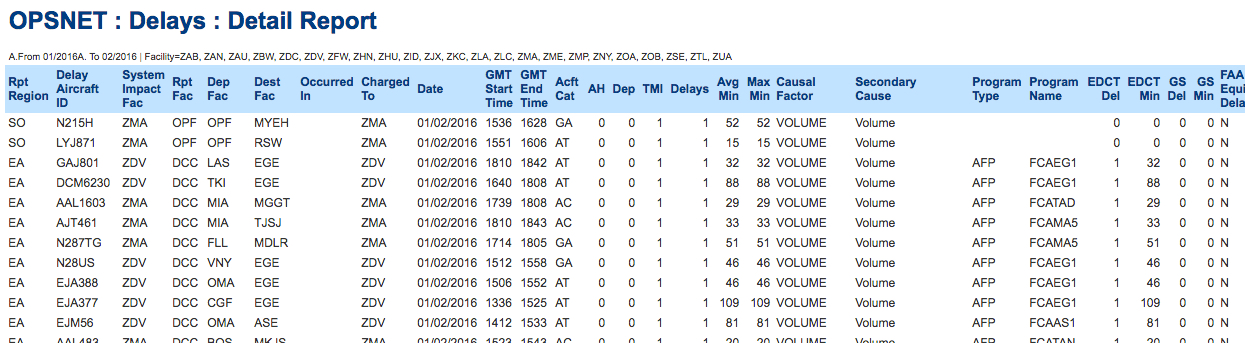

The definitions for the fields in the Detail Report for the Delays are presented below:
- Reporting Region. Two-letter regional identifier of the reporting facility. See FAA Region.
- Delay Aircraft ID. Identification number of the delayed aircraft (available only for individual delay entries).
- System Impact Facility. Facility that is assigned the delay.
- Reporting Facility. Three-letter identifier of the reporting facility
- Departing Facility. Facility the aircraft departed from.
- Destination Facility. Facility the aircraft landed at.
- Occurred In. ARTCC or TRACON where airborne holding delay occurred.
- Charged To. Three-letter identifier of the facility that bears the originating cause for delay (used only for TMI delay).
- Date. Local day of the reported delay.
- GMT Start Time. GMT start time of delay.
- GMT End Time. GMT end time of delay.
- Aircraft Category. Two-letter category of the aircraft delayed (recorded by FSA or the reporting facility). Permissible values are: Air Carrier (AC), Air Taxi (AT), General Aviation (GA), Military (MIL).
- AH. Delay type "Airborne Holding" (individual flight entry reported by PDARS).
- Dep. Delay type "Departure" (individual or group delay entry reported by FAA facility).
- TMI. Delay type "Departure TMI" (individual or group delay entry reported by FAA facility or DCC (EDCT/GS). TMI=Traffic Mangement Initiative.
- Delays. Total flights delayed per entry. Total delays attributed to the System Impact Fac.
- Average Minutes. Average minutes of delay for the record reported delay.
- Max Minutes. Maximum minutes of delay for the record reported delay.
- Causal Factor. The main cause for delay (per JO7210.55G). There are 5 categories: Weather, Volume, Runway/Taxiway, Equipment, Other.
- Secondary Cause. The second level cause for delay (per JO7210.55G), i.e., Aircraft Emergency, VIP Movement, Wind, Thunderstorm, etc.
- Program Type. Program/TMI type reported by DCC (AFP, CTOP, GDP, GS).
- Program Name. As recorded in the FAA Advisory "CTL ELEMENT" field when DCC issued the program. For AFP the name will be FCA name (i.e., FCAZHU1); for CTOP the name will be the CTP number (i.e., CTP001:SKI18); for GDP/GS the name will be the three-letter ID of the airport the program was initiated for.
- EDCT Delay. Total delayed flights reported as EDCT delay.
- EDCT Minutes. Total delayed minutes of EDCT delay.
- GS Delays. Total flights reported as GS delay.
- GS Minutes. Total delayed minutes of GS delay.
- FAA Equipment Delay. Identifies if delay is caused by FAA owned equipment (Y/N).
- Impacting Condition. The circumstance that caused the delay (includes the TMI type, root cause, and secondary cause if reported).
- Delay Remarks. Optional field, used by reporting facility when needed to explain contributing causal factors, conditions, or other pertinent information.
- Delay ID. Unique ID created when the TPC processes the data.
Field definitions for other OPSNET reports are available in Definitions of Variables.
For information about other available reports in the Delays view, see Delay Reports.


